
API & Integration
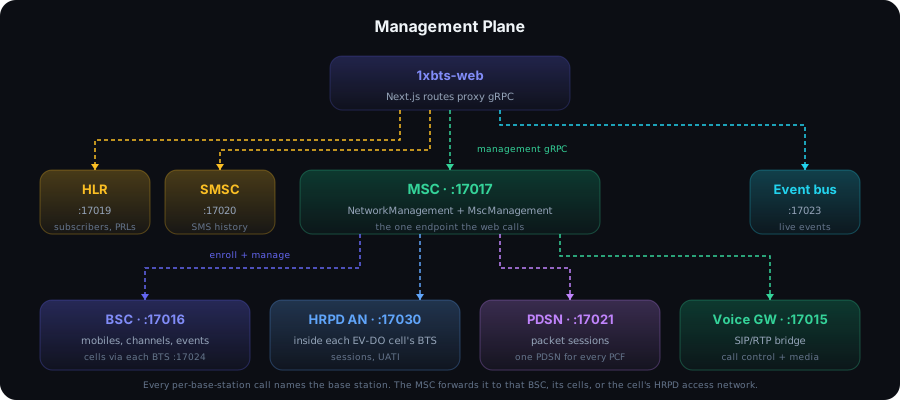
1xBTS uses gRPC for management, for the web dashboard, and for the service boundaries between components (HLR, SMSC, packet core, event bus, voice gateway). Standards interfaces keep their own transports: Abis, A1, A2p, A8/A9, and A10/A11 are not gRPC APIs.
Endpoints
| Endpoint | Default | Hosted by | Notes |
|---|---|---|---|
| Network management | 127.0.0.1:17017 | MSC | The one endpoint the web dashboard and operator tooling call. Calls, SMS, OTASP, and every radio, HRPD and packet view for every base station. |
| Base station management | 127.0.0.1:17016 | BSC | Enrollment plus per-base-station management. The MSC calls it; the web does not. |
| Cell management | 127.0.0.1:17024 | BTS | Enrollment plus radio metrics, IQ capture, and reverse power control for one cell. The BSC calls it. |
| HRPD access network | 127.0.0.1:17030 | BTS | HRPD sessions and UATI allocation for one EV-DO cell. The MSC calls it. |
| HLR service | 127.0.0.1:17019 | HLR | Subscribers, identities, registrations, PRLs, OTASP sessions |
| SMSC service | 127.0.0.1:17020 | SMSC | SMS submissions and delivery attempts |
| Packet service | 127.0.0.1:17021 | PDSN | Packet sessions |
| Event bus | 127.0.0.1:17023 | Event bus | Aggregated event stream across all components |
| Voice gateway | 127.0.0.1:17015 | Voice gateway | MSC-controlled SIP/RTP bridge control and media streams |
| 1xbts-web | http://localhost:3000 | Web dashboard | Next.js UI and SSE bridge |
Services
| Proto service | Hosted by | Purpose |
|---|---|---|
mgmt.v1.NetworkManagementService | MSC | Single management interface for the whole network. Each call names a base station (and, where relevant, a cell) and the MSC forwards it there, or fans out to every base station for network-wide views. |
msc_management.v1.MscManagementService | MSC | List base stations, initiate and list calls, send SMS, stream OTASP events |
base_station.v1.BaseStationService | BSC | Enrollment: reports the base station’s identity, A1 address and served cells to the MSC |
bsc_management.v1.BscManagementService | BSC | BSC status, mobiles, channels, access/paging/traffic event streams, power override |
bts_management.v1.BtsManagementService | BTS, and per cell on the BSC | Cell enrollment, status and config, radio metrics, IQ capture, reverse power control |
an.v1.AnService | BTS | HRPD sessions, UATI allocation and session events for one EV-DO cell |
hlr.v1.HlrService | HLR | Subscriber, identity, registration, PRL and OTASP session persistence |
smsc.v1.SmscService | SMSC | SMS submission and delivery persistence |
packet.v1.PacketService | PDSN | Packet session lifecycle and inspection |
events.v1.EventService | Event bus | Aggregated network events |
voice_gateway.v1.VoiceGateway | Voice gateway | Call control and media streams driven by the MSC |
StreamRadioMetrics includes TX hardware-margin and late-batch counters,
radio underflow/late/sequence status, real-time scheduling degradation counts,
and RX queue depth, queued airtime, and maximum residency. These fields help
distinguish an overloaded host from an RF or handset-side problem.
Web dashboard
1xbts-web reads four addresses, all set in docker-compose.yml:
| Variable | Default | Used for |
|---|---|---|
MSC_GRPC_ADDRESS | 127.0.0.1:17017 | All management: base stations, cells, mobiles, channels, calls, SMS, OTASP, HRPD sessions, packet sessions |
HLR_GRPC_ADDRESS | MSC host, port 17019 | Subscribers and PRLs |
SMSC_GRPC_ADDRESS | MSC host, port 17020 | SMS history |
EVENTS_GRPC_ADDRESS | 127.0.0.1:17023 | Live event stream |
The web never connects to a BSC, a BTS, the HRPD access network, or the PDSN directly. Browser clients talk to the web’s own API routes and receive SSE streams from it, and they do not open gRPC connections.
grpcurl Examples
grpcurl -plaintext localhost:17017 msc_management.v1.MscManagementService/ListBaseStationsgrpcurl -plaintext localhost:17017 msc_management.v1.MscManagementService/ListCallsgrpcurl -plaintext -d '{"destination_mdn":"5551234567","message":"test"}' \ localhost:17017 msc_management.v1.MscManagementService/SendSmsgrpcurl -plaintext localhost:17017 mgmt.v1.NetworkManagementService/ListAllMobilesgrpcurl -plaintext localhost:17019 hlr.v1.HlrService/ListSubscribersgrpcurl -plaintext localhost:17020 smsc.v1.SmscService/ListSmsSubmissionsgrpcurl -plaintext localhost:17021 packet.v1.PacketService/ListSessionsgrpcurl -plaintext -d '{}' localhost:17023 events.v1.EventService/ListenEventsPer-base-station calls on NetworkManagementService take a selector naming the base station id from msc.json (and a cell id where the call is cell-scoped):
grpcurl -plaintext -d '{"selector":{"base_station":"bts-1"}}' \ localhost:17017 mgmt.v1.NetworkManagementService/ListMobilesEventService
events.v1.EventService is the aggregated network event bus. Subscribe to ListenEvents to receive a long-lived stream of NetworkEvent messages from every component in the stack.
Envelope
| Field | Description |
|---|---|
timestamp | Server-assigned event time |
source | EventSource enum — BTS, BSC, MSC, PCF, PDSN, HLR, SMSC, NIB |
sequence | Monotonically increasing per-server sequence number |
producer_instance | Free-form producer label (e.g. "pdsn-0") |
body | oneof over per-component wrapper messages (PdsnEvent, BscEvent, …) |
Subscribing
# All eventsgrpcurl -plaintext -d '{}' localhost:17023 events.v1.EventService/ListenEvents
# Only PDSN eventsgrpcurl -plaintext -d '{"source_filter":["EVENT_SOURCE_PDSN"]}' \  localhost:17023 events.v1.EventService/ListenEvents
Publishing
Components publish events to the bus via the unary Publish RPC. Producers hold one long-lived gRPC channel and rely on HTTP/2 multiplexing for cheap per-event calls. Each Publish returns the server-assigned sequence number.
Per-component bodies
PdsnEvent—PacketSessionBoundandPacketSessionUnboundcarry subscriber identity, mobile IP, service option, and the A11 session reference.PacketSessionUnboundincludes a structuredPacketSessionUnbindReasonenum.BscEvent/MscEvent/PcfEvent/HlrEvent/SmscEvent/BtsEvent— per-component wrappers. Variants are added as producers come online.